
The immersive international of the polyhedric graffiti author, visible artist, musician, lyricist, performer, style clothier, innovator and thinker Rammellzee lands in Los Angeles this November. The exhibition surveys his oeuvre from his graffiti beginnings at the A educate within the mid-Nineteen Seventies to his effective arts and function observe evolved over the next 3 a long time.
A real iconoclast, Rammellzee dedicated to his pondering and art-making with an manner that used to be concurrently programmatic and shamanic. His esoteric manifestos encompassed philology and astrophysics and drew inspiration from fresh sensibility and medieval historical past alike. One among Rammellzee’s obsessions used to be a tale about medieval clergymen who evolved lettering so ornate to be deemed unreadable via the upper ranks of the clergy and in the end were given banned. In his imaginative and prescient, this tale used to be evidence of the subversive, anti-establishment attainable of lettering. It illuminated the trail in a similar fashion undertaken via graffiti artists, who via rendering a reputation mysterious and unrecognizable, may just release language from its intrinsic energy buildings. This used to be the start of Rammellzee’s philosophy, “Gothic Futurism,” and the creative manner referred to as “Ikonoklast Panzerism.”
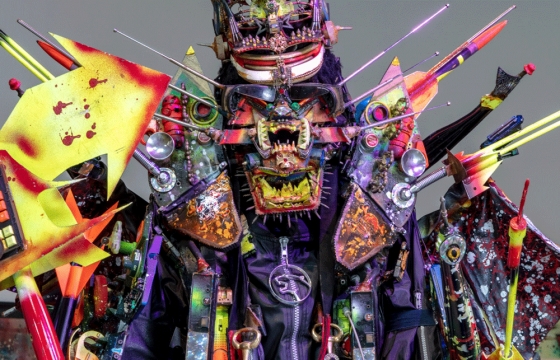
The weaponized letters of the alphabet have been, for Rammellzee, the muse for a fleet of spacecrafts for letter racing and galactic battles in a postapocalyptic sci-fi fable. Quintessentially DIY and but futuristic, the sculptural units of the Letter Racers are on view on the gallery. They exemplify probably the most facets on the core of Rammellzee’s means: enjoying with metaphysical ideas within the bodily international.
A part of a era that grew up throughout New York Town’s notorious monetary and infrastructure disaster, Rammellzee captured the decaying and lawless fact of the streets of Ny in thick layers of epoxy resin. Repurposed items and trash changed into creative gear to collect and create no longer most effective his Letter Racers but additionally a number of built sculptures, painterly assemblages and clothes for his performances. Via the early Nineteen Nineties, Rammellzee had originated an Olympus of characters and change egos made actual thru costumes, art work and built sculptures. He would embrace the Rubbish Gods of their full-body fits of armor, a few of which weighed greater than 100 kilos. Essentially the most paramount persona, The Gasholeer, used to be even equipped with a flamethrower.
Rammellzee used to be the embodiment of his artwork and theories. From time to time contradictory and polarizing, he may just enrage and amuse on the similar time. The magnetism of his inscrutable theoretical monologues can also be gave the impression to this date. The critic Carlo McCormick poignantly remarked in an Artforum overview from 1987: “Rammellzee’s artwork contains such a lot medical, army, and linguistic data that it’s laborious to not brush aside his complicated techno-poetry as self-indulgent babble. Conversely, alternatively, Rammellzee’s innate sense of lyricism provides his mannered, mathematical prose a top quality that attracts one in, and the seamlessness of his conceptual invention leads one to wonder if the that means is certainly decipherable and whether or not possibly it’s only our lack of know-how that makes it sound like gibberish.”
Rammellzee used to be born in Some distance Rockaway, Queens, in 1960 to folks of Italian and African American descent. In 1979, at nineteen, he legally modified his identify to the equation RAMM:ELL:ZEE. For the reason that Eighties, his paintings has been exhibited in galleries and museums and supported via global creditors. As a musician, Rammellzee invented a nasal rap taste referred to as “gangsta duck,” influential to artists such because the Beastie Boys and Cypress Hill. He seemed in Charlie Ahearn’s iconic movie Wild Taste (1982), and his 1983 track “Beat Bop”—produced and with a canopy design via Jean-Michel Basquiat—used to be featured prominently in Henry Chalfant and Tony Silver’s documentary Taste Wars (1983). Within the early 2000s, Rammellzee’s Rubbish Gods and his fleets of Letter Racers settled in his TriBeCa loft, referred to as the “Combat Station,” which he slightly left against the tip of his lifestyles. Rammellzee died in 2010 on the age of forty-nine. His start identify stays a thriller even to a couple of his closest buddies.
In 1979, Rammellzee met the graffiti artist A-One at a night magnificence at FIT. A-One offered him to the “Mitchell Staff,” the crowd of graffiti artists with whom he painted partitions and trains. The group used to be named after the housing undertaking within the South Bronx the place the individuals lived on the time: A-One at the 8th ground, Kool Koor on the second one ground, and Poisonous around the side road. The relationship with Rammellzee used to be quick and those artists joined him to develop into a part of TMK (Tag Grasp Killers), the graffiti group he based. “TMK used to be about protecting the letter,” says artist Kool Koor. To develop into a member of TMK, artists needed to turn out their ability via executing a letter of the alphabet in accordance with Rammellzee’s Ikonoklast Panzerism. Every artist spoke back to the duty of arming the letter of their private taste: Poisonous’s used to be extra summary, A-One’s figurative, and Kool Koor’s architectural. Gothic Futurism at Jeffrey Deitch includes a gallery curated via the artist Kool Koor documenting the paintings of TMK and the person universe of each and every artist.
Jeffrey Deitch met Rammellzee in 1980 and maintained a discussion with him for a few years. He used to be with Rammellzee and Jean-Michel Basquiat in Los Angeles in 1983 when Basquiat painted his iconic paintings Hollywood Africans that includes a self-portrait and portraits of the artist Poisonous and Rammellzee. Deitch and Rammellzee spent a number of years making plans a gallery exhibition, however the undertaking used to be by no means discovered. After the artist’s loss of life, Deitch recreated the “Combat Station” in collaboration with the artist’s spouse Carmela in his 2011 Artwork within the Streets exhibition on the Museum of Recent Artwork, Los Angeles. Gothic Futurism is Jeffrey Deitch’s first gallery exhibition in partnership with the Property of Rammellzee. In loving reminiscence of Carmela Zagari Rammellzee.